

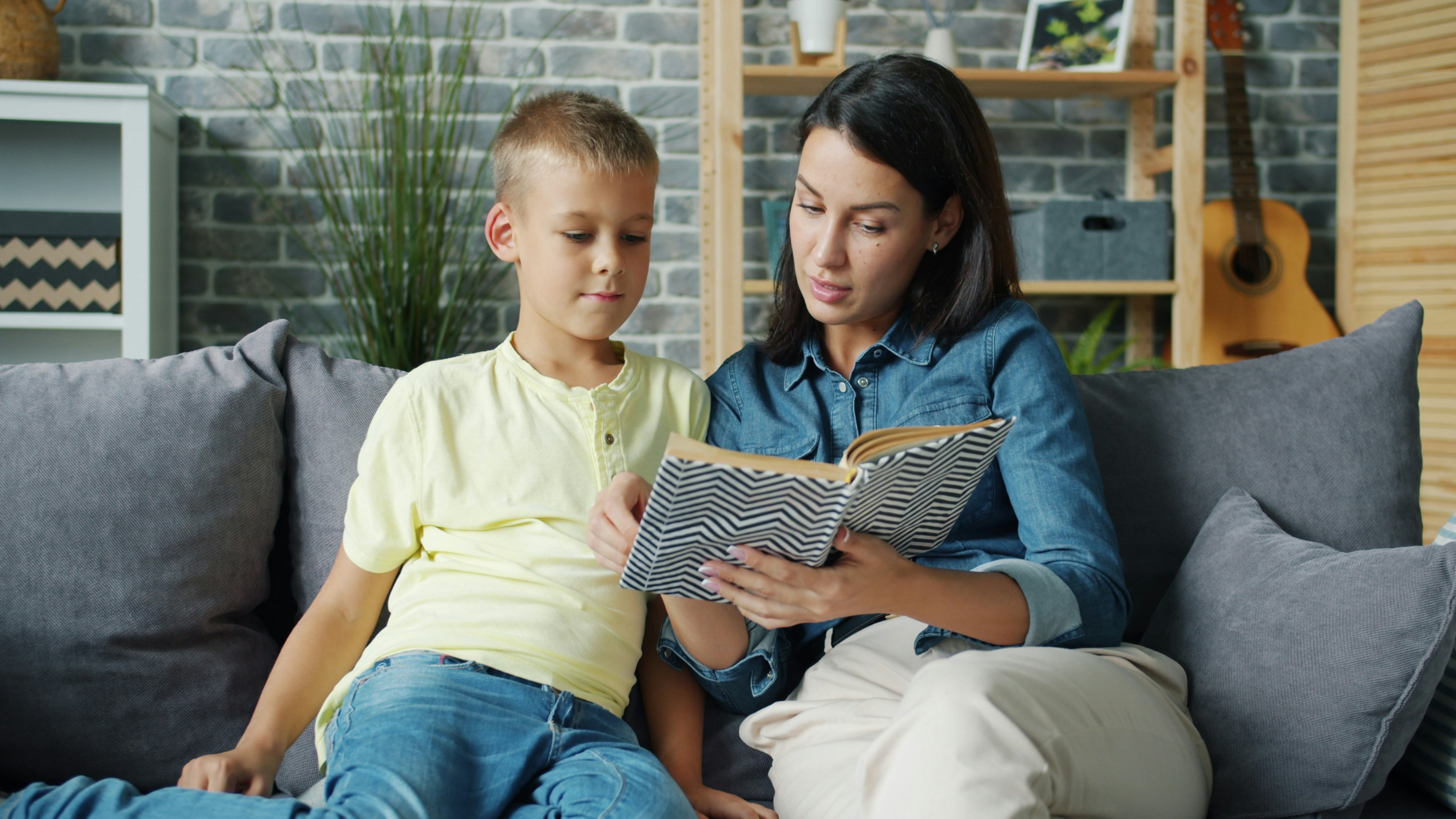
Something is happening. After years of content getting faster, louder, and shorter – after TikTok trained a generation to expect a new stimulus every fifteen seconds – parents and educators are noticing a countermovement. Children who sit patiently for a twenty-minute read-aloud. Teenagers who seek out long-form podcasts. Families who find that the most calming thing in their evening routine isn’t a screen turned off, but a screen used for something slow.
Storytelling is having a resurgence. And it couldn’t come at a better time.
👉 Jump to the channel recommendations
What fast content does to attention
The mechanics are well understood by now. Short-form video platforms are optimised for retention at the clip level – if you don’t hook a viewer in the first two seconds, you’ve lost them. That feedback loop shapes not just the content that gets made, but the minds that consume it. Children raised on a diet of ten-second clips aren’t just bored by slower content; they can struggle to tolerate the gap between a question being asked and it being answered. The delay feels unbearable.
This isn’t a moral panic – it’s a design problem. The platforms aren’t broken; they work exactly as intended. The issue is that what’s optimal for a platform’s engagement metrics isn’t necessarily optimal for a developing brain. The distinction between mindful and passive screen use is precisely this: whether content is asking something of the viewer, or simply holding their attention. Attention, like a muscle, needs to be exercised. It needs to be asked to sustain itself through the slow middle of a story, to hold a thread across multiple scenes, to wait for a resolution.
Storytelling – done well – is one of the few forms of screen content that asks this of children. And that, more than any particular moral lesson or educational value, is why it matters.
What good storytelling does differently
A story told well has an architecture that fast content deliberately avoids. There’s a beginning that establishes something – a character, a world, a problem. There’s a middle that complicates it. There’s an end that resolves it, or at least changes it. The viewer or listener has to hold all of that in mind simultaneously, updating their model of what’s happening as new information arrives. That’s cognitively demanding work. It also happens to be some of the most pleasurable work a brain can do.
Good storytelling also models something that algorithmically optimised content never does: it models patience. A skilled reader slowing down for a difficult word. A storyteller letting silence do some of the work. A narrator who trusts that the audience will stay if the story is worth staying for. Children absorb these rhythms. They learn, implicitly, that good things take time. This is closely related to the value of unstructured time and boredom – both require children to tolerate the absence of immediate stimulation, and both build the same capacity for sustained attention.
There’s also the matter of empathy. Research on the effects of narrative fiction consistently finds that reading – and, to a meaningful degree, hearing stories told well – builds the capacity to imagine lives other than your own. You can’t shortcut that. You have to spend time in someone else’s perspective, following their choices, feeling their consequences. Ten-second formats don’t have room for that. Stories do.
Where to find it
For the youngest children
CBeebies (BBC) The CBeebies Bedtime Stories series is one of the best things on YouTube for young children, full stop. Each video features a celebrity or well-known figure – from Tom Hardy to Dolly Parton – reading a picture book to camera in a warm, unhurried way. The format is simple and the production is quietly beautiful, shot in soft light with the book held up so children can follow along. It’s a model of what a screen read-aloud can be, and it works extraordinarily well as part of a wind-down routine. Best for: Ages 2-6
Storyline Online (SAG-AFTRA Foundation) Professional actors – including Viola Davis, Kevin Costner, and others – read picture books aloud on camera. That’s the whole format. It sounds simple, and it is, but hearing a great actor bring a book to life is something children respond to deeply. Storyline Online also features in our guide to the best YouTube channels for toddlers and under-5s alongside other channels suited to this age group. Excellent for bedtime, rainy afternoons, or just teaching children that stories read aloud can be extraordinary. Best for: Ages 3-8
For older children
Kids’ Poems and Stories with Michael Rosen Michael Rosen – former Children’s Laureate, poet, and author of We’re Going on a Bear Hunt – has been performing directly to camera on YouTube for years, and the channel is quietly one of the best things on the platform for this age group. The format is simple: just Rosen, a plain background, and a poem or story delivered with extraordinary physicality and warmth. Children who think they don’t like poetry tend to discover they do after ten minutes with this channel. It’s also one of the rare examples of oral storytelling in its most elemental form – a person, a story, and nothing else. Best for: Ages 5-10
For pre-teens
TED-Ed – Myths from Around the World (TED-Ed) TED-Ed’s main channel covers a vast range of topics, but buried within it is one of the best storytelling resources available for this age group: its myths and legends playlist. Each video is a short, beautifully animated retelling of a myth or folktale from a different culture – Greek, Norse, Aztec, Japanese, West African, and dozens more – narrated with real care for the shape and weight of the story. These aren’t dry summaries; they’re told as stories, with stakes, character, and a sense of wonder intact. For a pre-teen beginning to understand that narrative is something humans have always needed, and that the same story structures appear across wildly different cultures and centuries, this is genuinely illuminating content. It’s also a natural gateway to wanting to read the source material. Best for: Ages 9 and up
The bigger picture
None of this requires throwing screens out of the house. It requires being selective about what screens are used for – and recognising that not all screen time is equivalent. An hour watching CBeebies Bedtime Stories is doing something very different to an hour of short-form autoplay. The difference isn’t just content; it’s the kind of attention being exercised, and the kind of patience being built.
The resurgence of storytelling isn’t really a trend. It’s a correction. After years of content designed to eliminate the space for thought, slow and careful narrative is simply reasserting what it has always offered: the irreplaceable experience of being drawn into someone else’s world and choosing to stay there.
That’s something worth protecting.
If you’re looking for a way to curate storytelling content – and other quality channels – without handing children a recommendation algorithm, Streamu lets you build a custom feed of approved channels. No search bar, no autoplay, no rabbit holes.
