

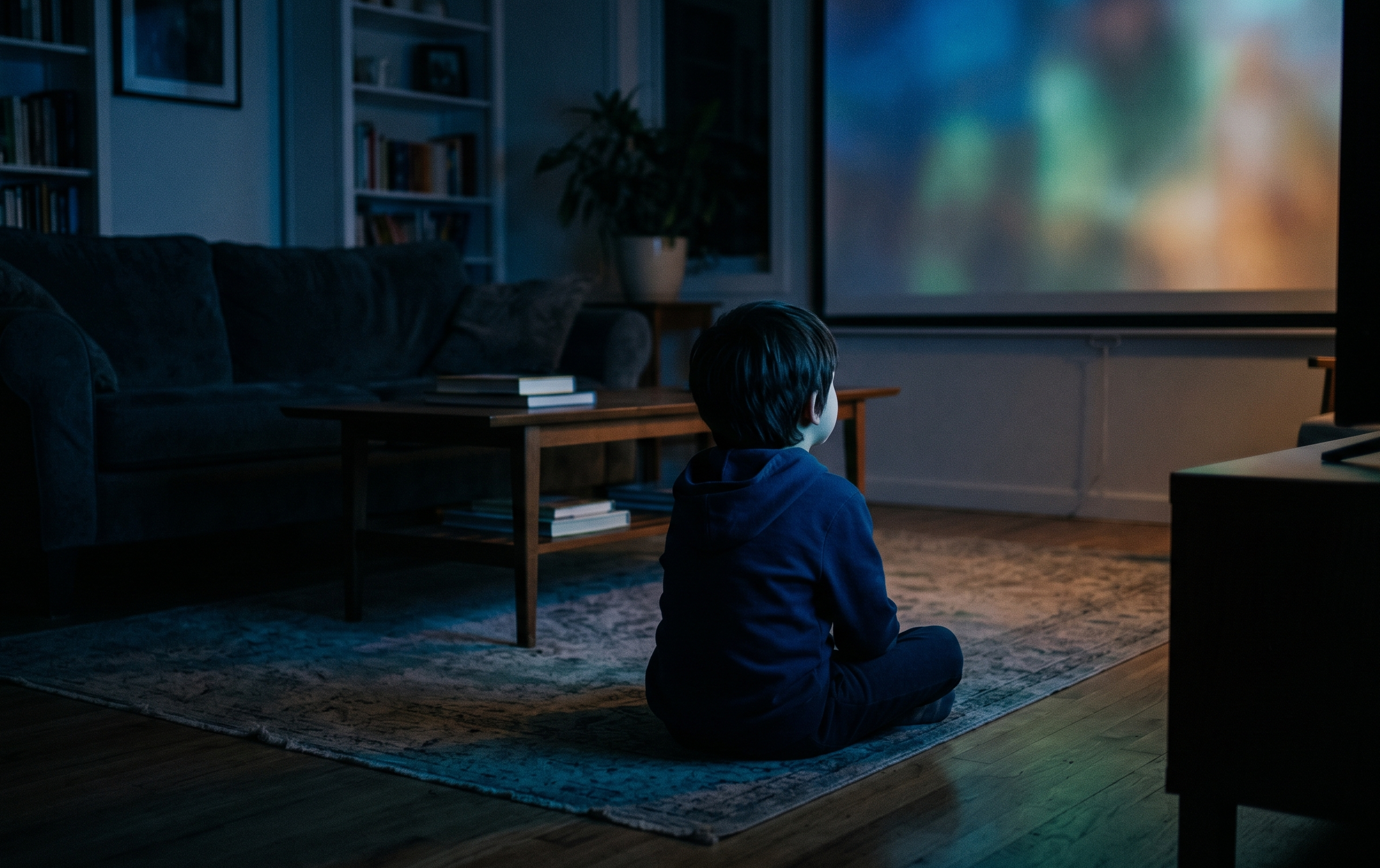
Your child sat down to watch one thing. Forty minutes later they’re watching something completely different. No single moment felt wrong. That’s algorithmic creep – and it’s by design.
Most parents are alert to obviously inappropriate content. They know what they’re looking for: explicit language, violent imagery, adult themes. What’s harder to see – and harder to explain to a child – is a process that doesn’t involve any single bad video, but ends up somewhere problematic regardless.
Algorithmic creep is the gradual drift that happens inside YouTube’s recommendation engine. It doesn’t require any one piece of content to be inappropriate. It works through accumulation – a series of individually unremarkable steps, each one a small move away from where the session started, that collectively arrive somewhere quite different.
How it works
YouTube’s algorithm is designed to maximise watch time. To do that, it doesn’t just serve what a viewer asked for – it serves what it predicts will keep them watching longest. And the way to keep someone watching is to serve content that’s slightly more stimulating than the last video. For a full explanation of how the algorithm works and what it means for children, see our dedicated guide here.
Each recommendation is calibrated against what just held the viewer’s attention. If a child watches a video about a science experiment to the end, the algorithm notes what worked – the pace, the format, the level of stimulation – and finds something slightly more engaging on the same axis. Then it does it again. And again.
The result is a session that begins somewhere reasonable and ends somewhere the parent wouldn’t have chosen, via a path that felt natural at every step. A child who starts watching a Minecraft tutorial ends up watching increasingly extreme Minecraft challenge videos. A child watching football highlights ends up watching confrontational sports commentary aimed at adults. A child watching nature videos ends up watching hunting footage.
No single transition looked wrong. The cumulative effect is a long way from where things started.
Why children are particularly vulnerable
The algorithm behaves this way with all viewers, but children face it with fewer defences.
Adults have a developed sense of their own preferences and limits – they notice when content starts to feel off and can make a deliberate choice to change course. Children, particularly younger ones, are still developing that self-awareness. They’re also more susceptible to the pull of increasingly stimulating content, because the prefrontal cortex – the part of the brain responsible for self-regulation and long-term thinking – is still maturing throughout childhood and into early adulthood.
Autoplay compounds the problem significantly. Without autoplay, there’s a natural break between videos – a moment where a child could notice that what they’re watching has drifted and choose differently. With autoplay on, each transition happens seamlessly, removing the one point in the process where course correction is most likely. Here’s exactly how autoplay works – and how to turn it off.
What algorithmic creep looks like in practice
It’s worth being concrete, because the abstract version is easy to dismiss. These are the kinds of drifts that happen regularly on YouTube, entirely through legitimate recommendations:
Educational to extreme. A child interested in chemistry watches experiment videos. The algorithm, optimising for engagement, gradually surfaces more dramatic experiments – bigger explosions, more dangerous reactions, content that’s moved from educational to spectacle-driven.
Gaming to conflict. A child watching gameplay videos ends up watching increasingly heated commentary, arguments between streamers, or content built around confrontation and outrage – formats that generate strong engagement signals.
Age-appropriate to age-ambiguous. A child watching cartoon content ends up watching fan-made content using the same characters in contexts that are harder to categorise – not clearly inappropriate, but not clearly appropriate either.
In each case, the parent who set a child up with a reasonable starting point would be surprised by where a session ended up. And in each case, no individual step was obviously the wrong one.
What actually stops it
Filtering doesn’t address algorithmic creep. Restricted Mode and YouTube Kids both filter the content pool – they try to remove clearly bad content from the universe of possible recommendations. But as long as the recommendation engine is running, the drift still happens within whatever pool remains. A filtered pool still contains more and less stimulating content, and the algorithm will still move towards the latter.
The only approach that stops algorithmic creep at its source is removing the algorithm’s ability to choose what comes next. That means curating the available content in advance – deciding which channels a child can access, rather than leaving those decisions to a recommendation engine.
If a child’s YouTube environment contains only channels their parent has reviewed and approved, the algorithm has no room to operate. There’s no adjacent content to drift towards. The session begins and ends within a set of channels that were chosen intentionally.
A viewing environment that doesn’t drift
Streamu removes the recommendation feed entirely. Your child’s YouTube experience is built from channels you’ve chosen – and the algorithm never gets to decide what comes next. No drift. No creep. Just the content you put there.
Join a growing community of conscious parents taking back control.

Leave a Reply