

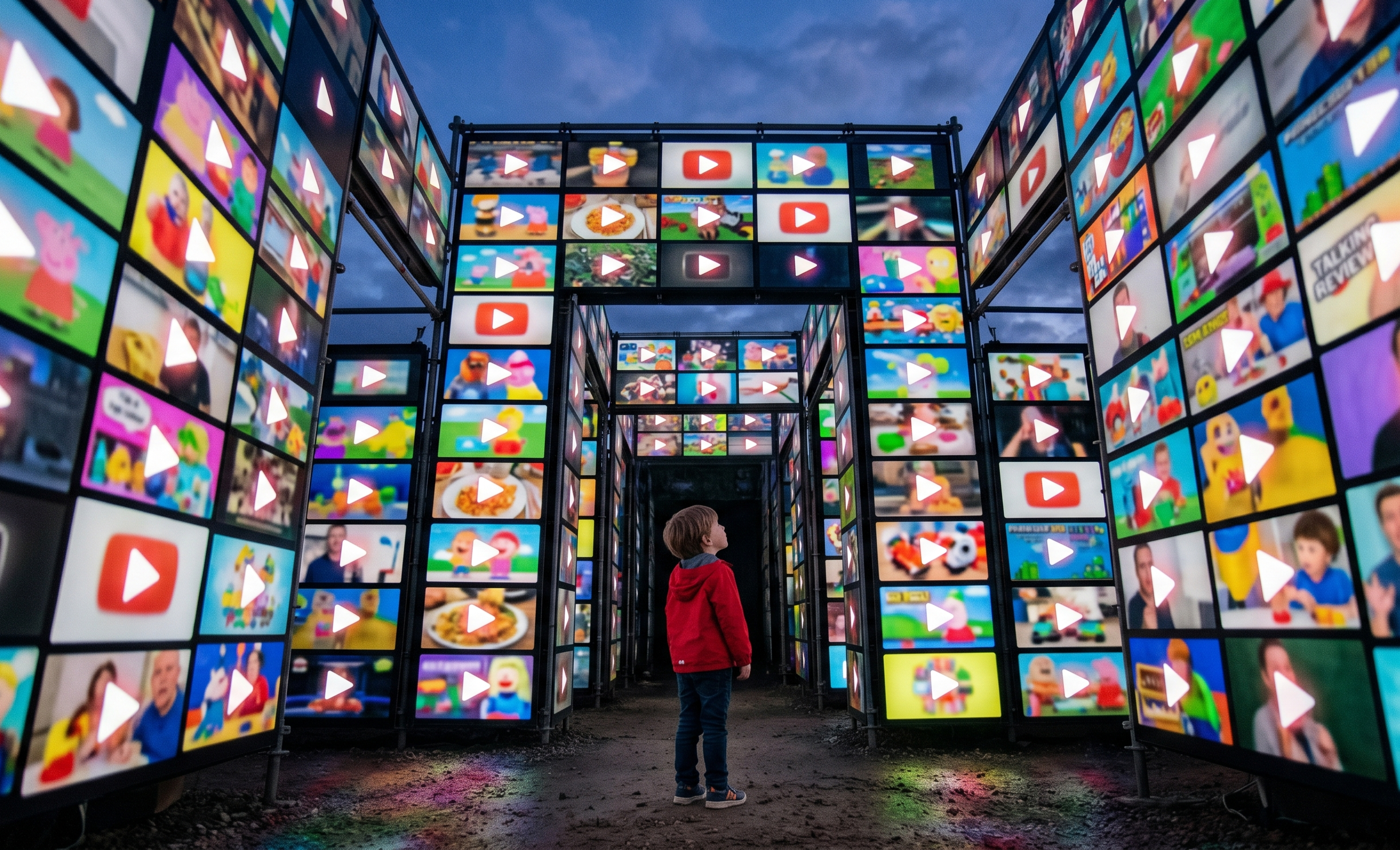
YouTube for children has a new problem – and it’s not the one most parents are looking for.
Ask most parents what they’re worried about on YouTube and they’ll say the same things: inappropriate language, violent content, unsuitable humour. The kind of thing you can see and immediately recognise as wrong.
AI-generated children’s content is a different kind of problem. It doesn’t look wrong at a glance. It looks fine – colourful, cheerful, apparently harmless. But it’s content produced at industrial scale by automated systems, designed to accumulate watch time rather than to entertain or educate children in any meaningful way. And YouTube is full of it. It’s the latest evolution of a problem that’s existed since the Elsagate era – content that exploits children’s attention for commercial gain.
Understanding what it is, how to recognise it, and why it matters is increasingly important for any parent whose child uses YouTube.
What AI-generated children’s content actually is
The term covers a range of approaches, but the common thread is content produced with minimal human creative input – using AI tools to generate scripts, voiceovers, visuals, or all three, and then uploaded in bulk to YouTube channels optimised for algorithmic discovery.
At its most basic, it looks like this: a synthetic voice reading out simple phrases or nursery rhymes over recycled cartoon visuals, uploaded dozens of times a day under slightly varied titles. At its more sophisticated end, it mimics the look and format of legitimate children’s education channels closely enough that the difference isn’t immediately obvious.
What these channels share is their objective. They’re not made by people who want to entertain children. They’re made – or generated – to capture watch time, attract ad revenue, and exploit YouTube’s recommendation algorithm, which rewards content that keeps young viewers engaged regardless of its quality or intent.
How to spot it
No checklist is foolproof, but there are reliable signals.
The voiceover sounds slightly off. AI-generated speech has improved enormously, but it still tends to lack natural variation in pace and emphasis. A voice that sounds smooth but oddly flat, or that mispronounces words in ways a human presenter wouldn’t, is a warning sign.
The channel uploads constantly. Legitimate children’s creators – the educators, storytellers, and presenters who put genuine effort into their content – typically upload weekly or fortnightly. A channel posting multiple videos per day is almost certainly automated.
The content is oddly repetitive. AI-generated videos often cycle through the same formats, phrases, or visual templates with minimal variation. If ten videos on a channel look nearly identical with minor differences, that’s not a creative series – it’s a content farm.
There’s no real presenter or personality. Human-led children’s channels have a person or a consistent creative voice at their centre. AI-generated content tends to be anonymous – no named presenter, no identifiable creative team, no social presence beyond the YouTube channel itself.
The title and description are stuffed with keywords. “Learn colours animals numbers ABC shapes for toddlers kids babies educational” is a title built for algorithmic discovery, not for a child or parent to read.
Why it matters beyond the obvious
The most immediate concern is quality – this content offers children nothing of value, and the time spent watching it is time not spent on content that’s actually engaging their curiosity or imagination.
But there’s a subtler problem. AI-generated content is specifically engineered to be maximally watchable – to hold attention through repetition, bright visuals, and simple stimulation without requiring any real cognitive engagement. It’s the purest expression of passive screen time, and it’s extremely effective at keeping young children watching.
The algorithm doesn’t distinguish between a thoughtfully made nature documentary and a factory-produced counting video. Both generate watch time. Both get recommended. And because AI-generated content can be produced far faster and in far greater volume than anything a human team can make, it increasingly dominates the results a child will encounter. This is one of the ways algorithmic creep compounds the problem – the more a child watches this content, the more the algorithm serves them.
What actually helps
Recognising AI-generated content is useful, but manually vetting every video your child might encounter isn’t realistic. The volume is too high and the quality signals too subtle for in-the-moment filtering to work reliably.
The more durable solution is the same one that addresses the algorithm problem more broadly: curate the environment rather than monitor the content. If the channels available to your child are ones you’ve personally reviewed and chosen – channels run by identifiable creators with a genuine track record – the question of whether any individual video is AI-generated becomes largely moot. It won’t appear, because it’s not on a channel you’ve approved.
That’s not a perfect solution to AI-generated content across the internet. But for YouTube – where the problem is most acute for young children – it removes the mechanism by which that content reaches them in the first place.
You don’t have to vet every video
Streamu lets parents build their child’s YouTube experience from a curated list of approved channels – real creators, real content, nothing generated at scale to exploit the algorithm. No surprises, no content farms, no synthetic voiceovers reading out numbers for the forty-seventh time.
Join a growing community of conscious parents taking back control.

Leave a Reply